Tuesday, 16 August 2011

Post-Modernism, Ai Weiwei and Banksy


1. Define Post-Modernism using 8-10 bullet points that include short quotes.
“Postmodernism was an attack on what had come before; it was an attack on modernism”, Adamson (2011).
It’s about the disillusionment of modernism.
In a Post-Modern world nothing has essential meaning anymore
It is suspicious of all truth claims because they are seen as attempts to control people.
It is against the idea of one grand narrative.
Relies on concrete experience over abstract principals.
It’s extremely sceptical of explanations and instead focuses on relative truths of each individual.
Social constructivism is another postmodern idea. One version of this idea is that “reality is created by social reality”, Saugstad (2001).
“Postmodernism is associated with relativism. Relativism is the idea that ‘anything goes’”, Saugstad (2001).
“It can be described as a set of critical, strategic and rhetorical practices employing concepts such as difference, repetition, the trace, the simulacrum, and hyperreality to destabilize other concepts such as presence, identity, historical progress, epistemic certainty, and the univocity of meaning,” Aylesworth (2010).

2. Use a quote by Witcombe (2000) to define the Post-Modern artist
“The post-modern artist is ‘reflexive’ in that he/she is self-aware and consciously involved in a process of thinking about him/herself and society in a deconstructive manner, ‘demasking’ pretentions, becoming aware of his/her cultural self in history, and accelerating the process of self-consciousness”, Witcombe (2000).

3. Use the grid on 42 and 43 to summarize the list of the features of Post-
Modernity.
I believe like many others that postmodernism is an attack on modernism because it undermines the manipulative ideologies of modernism by rejecting truth claims and grand narratives. This is seen in postmodern artwork where the artificiality of style is exposed and it is not used to convey ideologies. Instead postmodern artists believe that viewers should add their own personal interpretation for the work to be meaningful. Postmodern art still integrates elements of other art movements but art work does not try to elucidate its viewers with authority or interpretation.
As said in the ALVC resource book (page 43) postmodernism is a disruption of dominance and it is a mixture of cultural forms. Postmodern art is seen as a process, performance and production. It recycles culture, text, identity and is authenticated by the audience. Postmodernism is a play, it is ironic and it challenges seriousness. Anything goes with its hybridity of promiscuous genres, recombinant culture and intertextuality. Postmodernism sets no clear boundaries and makes anything possible.

4. Use this summary to answer the next two questions.

5. Research Chinese artist Ai Weiwei's 'Han Dynasty Urn with Coca-Cola logo'(1994)
in order to say what features of the work are Post-Modern.
'Han Dynasty Urn with Coca-Cola logo'(1994), Ai Weiwei


Ai Weiwei dropping a Han Dynast Urn.
Ai Weiwei is commonly described as a “postmodern Renaissance man”. As noted on WordPress (2011) he is known as China’s most politically vocal contemporary artist. His art questions communist authority and basic human rights.
The features of the ‘Hans Dynasty Urn with Coca-Cola logo’ which makes it postmodern is how it questions the grand narratives of China’s culture and ideologies, its disruption of China’s culture by adding the well known Coca-Cola logo and also how it challenges the thoughts of the viewers. Ai Weiwei’s is also a postmodern artist because his work is diverse and he uses many mediums. An example of this diversity is how he created a performance piece by smashing an old urn and documenting the process of his disruption with photographs.

6. Research British artist Banksy's street art, and analyze the following two works by the artist to discuss how each work can be defined at Post-Modern

'Flower Riot', Banksy

Los Angeles (2008), Banksy


Banksy is a seemingly unidentifiable but well heard of English street artist and is described as “a pioneer of the postmodern project,” Betbeze (2010). As Betbeze goes on to say his work is “embracing irony and surviving on an anarchic, law breaking process, he’s stretching the boundaries of genre and form while appearing to disregard them all together”. I think this statement sums up Banksy’s street art well and also shows us why he can be defined as a postmodern artist.
I think Banksy’s work ‘Flower Riot’ can be defined as postmodern art because it’s conversational and since it is ‘street art’ the work participates in the real order and it engages the viewer’s thoughts well. Work such as this and also Bansky’s graffiti of a cave man with McDonalds brings up important ideas of irony and hypocrisy in society. As Banksy (2006) is quoted “graffiti is not the lowest form of art... it’s actually one of the most honest art forms available... there is no elitism or hype.” These are all ideas of postmodernism and also show us why Banksy can be described as a postmodern artist.

Reference List
Banksy. (2006). Banksy wall and piece. London, England: Century.
Saugstad, A. (2001). Postmodernism: What is it, and what is wrong with it? http://goinside.com/01/1/postmod.html
Witcombe,C (2000) Modernism & Postmodernism. http://witcombe.sbc.edu/modernism/modpostmod.html
Brown, M. (2011). Postmodernism? London's V&A museum attempts a definition. http://www.guardian.co.uk/artanddesign/2011/feb/28/postmodernism-retrospective-london-v-and-a
Aylesworth, G. (2010). "Postmodernism", The Stanford Encyclopedia of Philosophy. http://plato.stanford.edu/archives/win2010/entries/postmodernism/
WordPress. (2011). Ai Weiwei: Without Fear or Favour, a BBC Documentary. http://designbento.wordpress.com/2011/07/20/ai-weiwei-without-fear-or-favour-a-bbc-documentary/
Betbeze, B. (2010). Banksy: a postmodern pioneer.                                 http://blastmagazine.com/the-magazine/culturefashion/arts/art/banksy-a-postmodern-pioneer/

Monday, 25 July 2011

Nathalie Djurberg's Claymations


1) What do you understand by the word ‘claymation’?

I associate the word ‘claymation’ with children, fantasy and the popular animations of Wallace and Gromit. My understanding of the word claymation is that it’s a form of animation which uses clay figures moulded into different positions for each stop-motion frame.

Still from Wallace and Gromit


2) What is meant by the term ‘surrealist garden of Eden’ and ‘all that is natural goes awry’?

As Regine (2009) says Djurberg’s installation ‘Experimentet’ is “an installation recreating a Garden of Eden from hell”. Her garden is described this way because of the larger than life crazily distorted creepy clay flowers and plants which gives it this feeling that the garden has indeed gone awry. The clay sculptures also dwarf the visitors of her exhibition, making it seem very surreal and dreamlike as well.


Photo take of Djurberg's Garden of Eden


3) What are the ‘complexity of emotions’ that Djurberg confronts us with?

As Ryberg (2005) points out the stories behind Djurberg’s claymations deal with such topics as violence, sexuality, sadism and assault, these are all a part of the darker side of the human soul. Anyone who views her work will be exposed to a ‘complexity of emotions’ because the topics are often feared by society. With the confrontation of these topics society’s perception of right and wrong are toyed with and a variety of emotions surface while viewing Djurberg’s work. Such emotions as shock, horror, fear, confusion, disgust, intrigue and many more may also be experienced.


Still from Djurberg's work where a girl is being dismembered


4) How does Djurberg play with the ideas of children’s stories, and innocence in some of her work?

Ways in which Djurberg plays with these ideas of children’s stories and innocence is with the use of claymation (normally associated with children and innocence), the imaginative fairytale/dreamlike settings of her claymations and also how remote everything is from reality.
As Yablonsky (2010) states while first viewing Djurberg’s work you may be mistaken in believing it could be the start of a children’s fairytale because of its sweetness in the beginning but the story quickly dissolves into grisly sadism. I think this all helps make her work very interesting because you are caught by surprise and left unaware of what will happen next.

Still from Djurberg's work We are not two, we are one.


5) There is a current fascination by some designers with turning the innocence and sweet into something disturbing. Why do you think this has come about?

I think this has come about because there aren’t really anymore restrictions on what is and isn’t acceptable in a lot of creative industries and lots of artists and designers like to push the boundaries further by exploring in areas which haven’t been explored and their want to create original work.

This current fascination of turning the innocent and sweet into something disturbing is met with viewers as well. I believe it’s because it’s something new and hasn’t been explored as extensively in other eras of. Another reason could be as Regensburger (2011) points out, “it’s a way for artists to say, ‘here’s this thing you know and understand, now consider it in a different way’. The effects, when it’s done right, can be surprising and jarring”.


6) In your opinion, why do you think Djurberg’s work is so interesting that it was chosen for the Venice Biennale?

I think her work is found to be so interesting and was chosen for the Venice Biennal because of the reasons I gave in question 5. For example her work is original, previously unexplored and there is something sweet and innocent about it which quickly turns into something disturbing and macabre. These are qualities which make her work so enchanting in a gruesome way. As Regine (2009) observed on three separate occasions her video installations were always “jam-packed with people drooling over her animations and taking photos”. I think this shows us the fascination with something new that people always seem to have. Also I think like Ryberg (2005) says her films seem to give an “existential feeling of suspense and uneasiness” which also is very captivating.


7) Add some of your own personal comments on her work

At my very first glance of her work I thought it was very incongruous but after viewing a few interviews with the artist I changed my mind. She deals with fear a lot in her work which is something everyone has but all of her puppets/clay-mates seem fearless in there gruesome acts which I find quite weird and I think this also makes her work so intriguing. I’m glad that her work is made out of clay because it makes it a little less real and easier for me to watch because I normally can’t stand watching scenes like these which I feel belong in a horror movie.


Reference List

Yablonsky, L. 2010. Clay mates. NY times.

Ryberg, H. 2005. Disturbing clay animation. Art news.org.

Regine. 2009. Venice Biennale: Nathalie Djurberg.

Regensburger, J. 2011. Human behaviour: Nathalie Djurberg with music by Hans Berg. Columbus underground.

Friday, 20 May 2011

Week 9 - Modernism and Post Modernism

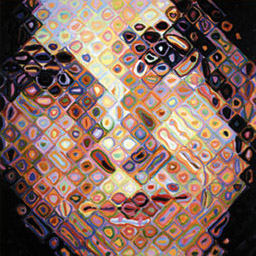
Maggie, (1996), Oil on canvas, 30 x 24"
(76.2 x 61 cm), Photograph by Ellen Page Wilson, courtesy of PaceWildenstein, New York, © Chuck Close
 

Self Portrait (1994). Chuck Close. Detail.

Water Lillies (1920) Claude Monet

Water Lillies (1920) Claude Monet.

1.Outline the intentions of each artist

Claude Monet
Claude Monet is known as an impressionist.  Impressionism is  “a theory or style of painting originating and developed in France during the 1870s, characterized by concentration on the immediate visual impression produced by a scene and by the use of unmixed primary colours and small strokes to simulate actual reflected light,” (thefreedictionary.com)
With his impressionistic style Monet was intent on capturing such things as colour, reflection, nature and also light and its constant changes. We can see this in the painting Water lilies (1920), and also in his painting’s called haystack series (1890-1891). This is a succession of paintings where a “series of haystacks are painted under different light conditions at different times of the day. He would rise before dawn, paint the first canvas for half an hour, by which time the light would have changed. Then he would switch to the second canvas, and so on. The next day he would repeat the process”, (webexhibits.org).

Images of paints of Monet's Haystack Series (1890-1891)


Chuck Close
Close is famous for his larger than life paintings of human heads (heads mainly of family and friends). In his earlier work he painted them in a photorealistic style, and later on his style changed and he started painting faces that were made up of a series of grids that contained abstract biomorphic shapes. Now his work is seen as a cross between abstraction and realism. He believes that the human face can show some ones attitude toward life with their expression and also with the way in which they have aged.  Close is also quoted in saying “I was trying to rip it loose of the context in which we normally saw portraits and normally saw people, and try to make it a scanning experience, an experience of stumbling through this landscape,” (whitecube.com, 2007)


2.Describe the techniques of each artist.

Claude Monet
As Monet was an impressionist painter he painted what he saw with a limited palette and "built up texture through his brush strokes, which vary from thick to thin, with tiny dabs of light, adding contours for definition and colour harmonies, working from dark to light," (Boddy-Evans). He also painted on a light coloured canvas and often painted the same subject over and over but with different variables such as light.

Chuck Close
In the painting Maggie (1998), Close uses a series of abstracted grids to form the face of his daughter Maggie. To create this painting, "he translates a photograph once taken by him into a painting in a pixelwise manner, using various techniques," (hermitagemuseum.org, 2008). This is then used to help him create his painting with the use of bold colours and oil on canvas.


3. Find 2 quotes about each artists work, and reference them correctly

Claude Monet
“As he entered the twentieth century, Monet was already sixty and no longer the struggling bohemian who fought the stultifying conventions of the French Academy. Now prosperous and settled in Giverny, he might have retired into comfortable self-parody. Instead, he devoted another quarter of a century to wrestling with the contradictions of vision and representation, and found a way to capture the lessons of reflection, refraction, and transparency, which he learned from looking into a water garden,” (Rosoff,2011).

“Claude Monet and the Impressionists were the forward thinkers and painters of their time. They used quick brushstrokes and a rapid pace to capture lively outdoor scenes.

    Inspired by the colors and shadows revealed by sunlight, the Impressionists typically worked outside, without many preliminary sketches or drafts. This was in direct contrast to the conservative traditions of the time, where painters remained indoors, confined to their studios, working on crisp, sharply rendered images,” (Simkus, 2010).


Chuck Close
“Chuck Close's monumental paintings of his friends, family and himself are instantly recognisable. Photographically realistic from a distance, upon closer inspection the portraits reveal themselves as the accumulation of hundreds of geometric shapes -- circles and triangles of different colours inside diamonds and rectangles,” (Mason, 2009).

“It may be significant that, whereas in art criticism old art is seldom if ever found to contain this commodity, current work is thought to abound in it. Mr. Close said in an interview not long ago that he wanted his works to be 'intimate experiences,' and also to have 'lots of small bits of information.' That way, he said, viewers can experience the ''initial confrontation'' with the whole portrait then, drawing nearer, can 'find lots of stuff to deal with,’” (Raynor, 1983).

4. Note 3 similarities of the work of both artists.

There are a few similarities between the work of the artists Close and Monet, some being:
·         Both artists are very passionate about their work and both like to create a series of work around the same subject matter to capture different elements which couldn’t be captured with just one painting on their chosen subject.
·         Both Close and Monet have used bold colours in their later works, normally not mixing the colours and leaving them separate on the canvas.
·         Both artists have painted subject matters which are of a modernist style and are un-idealised. Monet of landscapes and Close of portraits.
·         Both Monet and Close are also considered to be influential artists of their times.


5. What are some differences between the artist's work. (At least 3).

There are many differences between Close and Monet’s paintings, some being:
·         The obvious, Monet paints landscapes and Close paints portraits.
·         Monet is considered as an impressionist whereas Close is known for his realism and abstract art.
·         Close uses oil paint on canvas and Monet used acrylic on canvas.
·         Monet uses short sharp strokes to create his paintings whereas Close paints in a more systematic way with long thick lines and a grid formation for his work.


6. Describe your response to the work of both artists.

Close working on a painting in his workshop

I really enjoyed researching and comparing both artists to one another. I’ve heard of Monet before as he is a very famous artist but I’d never heard of Close. It was interesting for me to learn that after Closes health left him paraplegic he taught himself to paint again and now straps a paint brush to his hand to create his paintings. I find this very inspiring because a lot of people would give up if they were in this position.

I also liked learning about the two different styles in which Close painted and I think his earlier photorealistic paintings are breath taking. I also believe this of Monet’s work.

The way in which Monet has an eye for capturing light in his work so effectively is stunning. I loved looking at images of all his paintings and would love to have a talent like Monet.

Overall I think both artists are amazing and would love to view both of their works up close in a gallery.


Reference List

Rosoff,P. (2011) Monet’s water lilies: an artist’s obsession. Art New England, 32(3).

Simkus,J.(2010). Modern impressions. Arts and activities, 148(3) 34-5.

Mason, B. (2009). How grandma’s crochet inspired my artistic vision. Art newspaper, 18(44).

Impressionism.
http://www.thefreedictionary.com

Monet’s colours.

Boddy-Evans, M. Palettes and techniques of the impressionist masters: Claude Monet.

(2008). Chuck Close: seven portraits.

(2007). Chuck Close: Family and Others.


Week 8 - Industrialisation, Modernism and Architecture

 Research both architectural structures in order to comment on;
-the importance of the design and construction
-significance of the materials
-significance of the designer
-function for which each was built
-function now-has it changed?

Compare the two architectural structures, by noting their similarities and differences.


Eiffel Tower (1889) Gustave Eiffel


The Eiffel tower was built in 1889 by French engineer and bridge builder Alexandre Gustave Eiffel purely for the Paris Exposition of 1889, the world’s fair that marked the centennial celebration of the French Revolution. As quoted by Dr. Lori, “the monument had no practical function and was simply constructed as an attraction for the Paris World’s Fair”. Eiffel won a competition for his tower design and this is the reason the tower was built.

“The tower is 300 m (984 ft) high and consists of an open iron framework making it the highest manmade structure in the world at the time. It was the largest attraction at the Exposition and today it remains the most recognized structure in all of Europe,” (JJS gallery).  It took 300 iron workers, 2 engineers, 1 architect and 1 contractor (Gustave Eiffel) 2 years to make. It is made up of 18,038 iron pieces and 2,500,000 iron rivets. The Eiffel tower design and construction was very innovative for its time and according to engology.com, its use of wrought iron initiated a new age of tall buildings constructed of iron and steel. As King states the tower is “a monument to nineteenth century architectural engineering.”

Later uses of the Eiffel tower included Eiffel’s own use of it for wind tunnel experiments and as a meteorological observation post. In the beginning of the 20th century it functioned as a radio transmitter and in 1957 was also used for FM radio and television. Nowadays it is seen as a major tourist attraction as it’s France’s most iconic building and is also one of the most recognisable structures in the world.


Guggenheim Museum, Bilbao (1997) Frank Gehry


For the plans of a new Guggenheim museum in Bilbao a competition was similarly created (like the Paris Exposition competition) to produce a conceptual design and three architects were invited to participate. Gehry an architect from the United States ended up winning and his ideas of the museum having titanium curves and a soaring glass atrium was made into reality and was built in 1997. “The resulting architecture is sculptural and expressionistic, with spaces unlike any others for the presentation of art. The museum is seamlessly integrated into the urban context, unfolding its interconnecting shapes of stone, glass, and titanium on a 32,500-square-meter site along the Nervión River in the old industrial heart of the city,” (Guggenheim.org).

Unlike Alexandre Eiffel the designer of the Bilbao Guggenheim museum (Frank O. Gehry) was an architect. Gehry is known for his modern expressionist style and as mentioned by greatbuildings.com, Gehry is often discussed in architecture circles for his signature abstract, free form and curvaceous sculptural style.

The Bilbao Museum is one of five Guggenheim Museums around the world that makes up the Guggenheim foundation which “has been a preeminent institution for the collection, preservation and research of modern and contemporary art,” (Guggenheim.org). Unlike the Eiffel tower that as mentioned before was not made to have a practical function the Guggenheim museum is meant to unite great architecture with great artworks.

The Guggenheim Museum Bilbao forever changed the way the world thinks about museums, and it continues to challenge our assumptions about the connections between art, architecture, and collecting,” (Guggenheim.org). I believe this quote shows that Gehry is an innovative designer just like Eiffel was and even though the structural designs are very different they have both created iconic masterpieces of their times.


Reference List

Dr. Lori. Eiffel Tower.

Alexandre Gustave Eiffel ( 1832 - 1923 ) Structural and Chemical Engineer
     http://www.engology.com/articleeiffel.htm

Guggenheim museum Bilbao.

The Eiffel tower, Paris, 1889.

Guggenheim Museum Bilbao.

Monday, 9 May 2011

Week 7 - Industrialisation and Cao Fei's RMB City


1 What and when was the Industrial Revolution
The Industrial Revolution was an era that occurred during the 18th and 19th centuries. It began in England and slowly spread to a few other Western countries such as the United States, Germany and some parts of Scandinavia. As defined by Hacket (1992), “The Industrial Revolution is the name given to the movement in which machines changed people’s way of life as well as their methods of manufacture”. Some important changes that occurred during this era are the invention of machines, the use of steam and other kinds of power and also the adoption of factory systems. All of these innovations dramatically changed society and an increase in population and urbanization occurred.

2. Research both Modernist paintings in order to comment on the subject matter, form and style used to celebrate the machine and motion in each painting. Answer the question in 2 parts for each painting.

Dynamism of a dog on a leash (1912) Giacomo Balla

This painting by Balla is a cropped scene of a widows feet and her dachshund dog. As described by Lubbock (2009), it’s of ground level perspective, the human world is reduced and it’s a close up of the dog’s view of the world. The limbs of both the dog and the woman have been used in this painting to indicate bodies in motion. This has been done by the ladies blurred multiple feet, the many swinging leads, the obscure outlines and also the dogs various tails and feet. I think this painting imitates and celebrates the machine in motion with the almost mechanised movement shown with the indistinct image of both the widow and her dog.

The City Rises (1910) Umberto Boccioni

Boccioni’s painting The City Rises shows men labouring on a construction site with the help of their powerful horses. The theme of this work is the construction of a modern building and it depicts power, strength and energy with the use of bold and dramatic colours that evoke action. I think the vibrant energetic brush strokes used to create the blur of movements within the painting helps to capture the essence of futurism. “This painting is said to epitomize futurist painting, according to Boccioni, in its ‘synthesis of work, light and movement,’” (Wildy, 2010).

3. Research Cao Fei's RMB City (2007-9) in order to comment on this work in more depth.
i.e what images has she used in her digital collage that refer to China's present and history, and why has she used these.

RMB City (2007-9) Cao Fei

Fei has used such images as the iconic Chinese panda and the Beijing national stadium to combine ancient and modern Chinese architecture and to reflect on Chinas recent urban and cultural explosion. Her work explores ideas about urbanism, economy, imagination and freedom by mixing popular aesthetics with surrealism. As Serpentine Gallery (2008) states her work “comments on the rapid and chaotic changes that are occurring in all facets of Chinese society”.

4. RMB City is described as a utopia/dystopia. Comment on what these terms mean, and how they can be applied to the work.
One of the definitions of utopia is that it’s an imaginary island that is ideal and is a place of social perfection. Dystopia meaning pretty much opposite, it’s defined as an imaginary place or state in which the condition of life is extremely bad. I believe Fei has juxtaposed these two ideas in her work RMB city to reflect on her ideas on Chinas recent urbanization.  
“RMB City is a spectacular utopian/dystopian island-metropolis, where candy-striped smoke stacks suggest continuous industrial production, missiles make unremitting pre-emptive strikes, and ships move goods swiftly in and out of port. A giant shopping cart, filled with skyscrapers and religious monuments, floats nearby” (Art Space, 2009). 

5. Although the Modernist paintings and the contemporary digital work have emerged from
different contexts, there are also many similarities. Comment on the similarities that you can see in the work. Look at the moving digital image atvimeo.com/4272260, if you have not
already researched it
The similarities which I noticed first in the above modernistic paintings and Fei’s work, is that the ideas of technology and movement is evident in both. The modernist paintings that have been used as examples above are of a futurist style and deal with these ideas. These concepts have also been addressed in Fei’s work. Even though these modernistic paintings are very different in style compared to Fei’s virtual city, I can see that some of the fundamental ideas behind the works are the same; for example Boccioni’s painting depicts power, strength and energy which is also depicted in Fei’s city.


Reference List

Hackett, L. (1992). Industrialization: the first phase.

Lubbock, T. (2009, September 4). Great works: dynamism of a dog on a leash (1912) Giacomo Balla.

Serpentine Gallery, (2008). Cao Fei: RMB city

Wildy, J. (2010, September 1). Futurism and Umberto Boccioni’s the city rises.