Friday, 20 May 2011

Week 9 - Modernism and Post Modernism

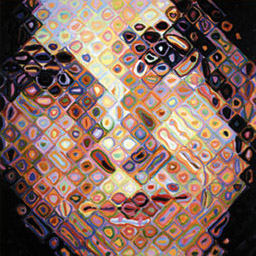
Maggie, (1996), Oil on canvas, 30 x 24"
(76.2 x 61 cm), Photograph by Ellen Page Wilson, courtesy of PaceWildenstein, New York, © Chuck Close
 

Self Portrait (1994). Chuck Close. Detail.

Water Lillies (1920) Claude Monet

Water Lillies (1920) Claude Monet.

1.Outline the intentions of each artist

Claude Monet
Claude Monet is known as an impressionist.  Impressionism is  “a theory or style of painting originating and developed in France during the 1870s, characterized by concentration on the immediate visual impression produced by a scene and by the use of unmixed primary colours and small strokes to simulate actual reflected light,” (thefreedictionary.com)
With his impressionistic style Monet was intent on capturing such things as colour, reflection, nature and also light and its constant changes. We can see this in the painting Water lilies (1920), and also in his painting’s called haystack series (1890-1891). This is a succession of paintings where a “series of haystacks are painted under different light conditions at different times of the day. He would rise before dawn, paint the first canvas for half an hour, by which time the light would have changed. Then he would switch to the second canvas, and so on. The next day he would repeat the process”, (webexhibits.org).

Images of paints of Monet's Haystack Series (1890-1891)


Chuck Close
Close is famous for his larger than life paintings of human heads (heads mainly of family and friends). In his earlier work he painted them in a photorealistic style, and later on his style changed and he started painting faces that were made up of a series of grids that contained abstract biomorphic shapes. Now his work is seen as a cross between abstraction and realism. He believes that the human face can show some ones attitude toward life with their expression and also with the way in which they have aged.  Close is also quoted in saying “I was trying to rip it loose of the context in which we normally saw portraits and normally saw people, and try to make it a scanning experience, an experience of stumbling through this landscape,” (whitecube.com, 2007)


2.Describe the techniques of each artist.

Claude Monet
As Monet was an impressionist painter he painted what he saw with a limited palette and "built up texture through his brush strokes, which vary from thick to thin, with tiny dabs of light, adding contours for definition and colour harmonies, working from dark to light," (Boddy-Evans). He also painted on a light coloured canvas and often painted the same subject over and over but with different variables such as light.

Chuck Close
In the painting Maggie (1998), Close uses a series of abstracted grids to form the face of his daughter Maggie. To create this painting, "he translates a photograph once taken by him into a painting in a pixelwise manner, using various techniques," (hermitagemuseum.org, 2008). This is then used to help him create his painting with the use of bold colours and oil on canvas.


3. Find 2 quotes about each artists work, and reference them correctly

Claude Monet
“As he entered the twentieth century, Monet was already sixty and no longer the struggling bohemian who fought the stultifying conventions of the French Academy. Now prosperous and settled in Giverny, he might have retired into comfortable self-parody. Instead, he devoted another quarter of a century to wrestling with the contradictions of vision and representation, and found a way to capture the lessons of reflection, refraction, and transparency, which he learned from looking into a water garden,” (Rosoff,2011).

“Claude Monet and the Impressionists were the forward thinkers and painters of their time. They used quick brushstrokes and a rapid pace to capture lively outdoor scenes.

    Inspired by the colors and shadows revealed by sunlight, the Impressionists typically worked outside, without many preliminary sketches or drafts. This was in direct contrast to the conservative traditions of the time, where painters remained indoors, confined to their studios, working on crisp, sharply rendered images,” (Simkus, 2010).


Chuck Close
“Chuck Close's monumental paintings of his friends, family and himself are instantly recognisable. Photographically realistic from a distance, upon closer inspection the portraits reveal themselves as the accumulation of hundreds of geometric shapes -- circles and triangles of different colours inside diamonds and rectangles,” (Mason, 2009).

“It may be significant that, whereas in art criticism old art is seldom if ever found to contain this commodity, current work is thought to abound in it. Mr. Close said in an interview not long ago that he wanted his works to be 'intimate experiences,' and also to have 'lots of small bits of information.' That way, he said, viewers can experience the ''initial confrontation'' with the whole portrait then, drawing nearer, can 'find lots of stuff to deal with,’” (Raynor, 1983).

4. Note 3 similarities of the work of both artists.

There are a few similarities between the work of the artists Close and Monet, some being:
·         Both artists are very passionate about their work and both like to create a series of work around the same subject matter to capture different elements which couldn’t be captured with just one painting on their chosen subject.
·         Both Close and Monet have used bold colours in their later works, normally not mixing the colours and leaving them separate on the canvas.
·         Both artists have painted subject matters which are of a modernist style and are un-idealised. Monet of landscapes and Close of portraits.
·         Both Monet and Close are also considered to be influential artists of their times.


5. What are some differences between the artist's work. (At least 3).

There are many differences between Close and Monet’s paintings, some being:
·         The obvious, Monet paints landscapes and Close paints portraits.
·         Monet is considered as an impressionist whereas Close is known for his realism and abstract art.
·         Close uses oil paint on canvas and Monet used acrylic on canvas.
·         Monet uses short sharp strokes to create his paintings whereas Close paints in a more systematic way with long thick lines and a grid formation for his work.


6. Describe your response to the work of both artists.

Close working on a painting in his workshop

I really enjoyed researching and comparing both artists to one another. I’ve heard of Monet before as he is a very famous artist but I’d never heard of Close. It was interesting for me to learn that after Closes health left him paraplegic he taught himself to paint again and now straps a paint brush to his hand to create his paintings. I find this very inspiring because a lot of people would give up if they were in this position.

I also liked learning about the two different styles in which Close painted and I think his earlier photorealistic paintings are breath taking. I also believe this of Monet’s work.

The way in which Monet has an eye for capturing light in his work so effectively is stunning. I loved looking at images of all his paintings and would love to have a talent like Monet.

Overall I think both artists are amazing and would love to view both of their works up close in a gallery.


Reference List

Rosoff,P. (2011) Monet’s water lilies: an artist’s obsession. Art New England, 32(3).

Simkus,J.(2010). Modern impressions. Arts and activities, 148(3) 34-5.

Mason, B. (2009). How grandma’s crochet inspired my artistic vision. Art newspaper, 18(44).

Impressionism.
http://www.thefreedictionary.com

Monet’s colours.

Boddy-Evans, M. Palettes and techniques of the impressionist masters: Claude Monet.

(2008). Chuck Close: seven portraits.

(2007). Chuck Close: Family and Others.


Week 8 - Industrialisation, Modernism and Architecture

 Research both architectural structures in order to comment on;
-the importance of the design and construction
-significance of the materials
-significance of the designer
-function for which each was built
-function now-has it changed?

Compare the two architectural structures, by noting their similarities and differences.


Eiffel Tower (1889) Gustave Eiffel


The Eiffel tower was built in 1889 by French engineer and bridge builder Alexandre Gustave Eiffel purely for the Paris Exposition of 1889, the world’s fair that marked the centennial celebration of the French Revolution. As quoted by Dr. Lori, “the monument had no practical function and was simply constructed as an attraction for the Paris World’s Fair”. Eiffel won a competition for his tower design and this is the reason the tower was built.

“The tower is 300 m (984 ft) high and consists of an open iron framework making it the highest manmade structure in the world at the time. It was the largest attraction at the Exposition and today it remains the most recognized structure in all of Europe,” (JJS gallery).  It took 300 iron workers, 2 engineers, 1 architect and 1 contractor (Gustave Eiffel) 2 years to make. It is made up of 18,038 iron pieces and 2,500,000 iron rivets. The Eiffel tower design and construction was very innovative for its time and according to engology.com, its use of wrought iron initiated a new age of tall buildings constructed of iron and steel. As King states the tower is “a monument to nineteenth century architectural engineering.”

Later uses of the Eiffel tower included Eiffel’s own use of it for wind tunnel experiments and as a meteorological observation post. In the beginning of the 20th century it functioned as a radio transmitter and in 1957 was also used for FM radio and television. Nowadays it is seen as a major tourist attraction as it’s France’s most iconic building and is also one of the most recognisable structures in the world.


Guggenheim Museum, Bilbao (1997) Frank Gehry


For the plans of a new Guggenheim museum in Bilbao a competition was similarly created (like the Paris Exposition competition) to produce a conceptual design and three architects were invited to participate. Gehry an architect from the United States ended up winning and his ideas of the museum having titanium curves and a soaring glass atrium was made into reality and was built in 1997. “The resulting architecture is sculptural and expressionistic, with spaces unlike any others for the presentation of art. The museum is seamlessly integrated into the urban context, unfolding its interconnecting shapes of stone, glass, and titanium on a 32,500-square-meter site along the Nervión River in the old industrial heart of the city,” (Guggenheim.org).

Unlike Alexandre Eiffel the designer of the Bilbao Guggenheim museum (Frank O. Gehry) was an architect. Gehry is known for his modern expressionist style and as mentioned by greatbuildings.com, Gehry is often discussed in architecture circles for his signature abstract, free form and curvaceous sculptural style.

The Bilbao Museum is one of five Guggenheim Museums around the world that makes up the Guggenheim foundation which “has been a preeminent institution for the collection, preservation and research of modern and contemporary art,” (Guggenheim.org). Unlike the Eiffel tower that as mentioned before was not made to have a practical function the Guggenheim museum is meant to unite great architecture with great artworks.

The Guggenheim Museum Bilbao forever changed the way the world thinks about museums, and it continues to challenge our assumptions about the connections between art, architecture, and collecting,” (Guggenheim.org). I believe this quote shows that Gehry is an innovative designer just like Eiffel was and even though the structural designs are very different they have both created iconic masterpieces of their times.


Reference List

Dr. Lori. Eiffel Tower.

Alexandre Gustave Eiffel ( 1832 - 1923 ) Structural and Chemical Engineer
     http://www.engology.com/articleeiffel.htm

Guggenheim museum Bilbao.

The Eiffel tower, Paris, 1889.

Guggenheim Museum Bilbao.

Monday, 9 May 2011

Week 7 - Industrialisation and Cao Fei's RMB City


1 What and when was the Industrial Revolution
The Industrial Revolution was an era that occurred during the 18th and 19th centuries. It began in England and slowly spread to a few other Western countries such as the United States, Germany and some parts of Scandinavia. As defined by Hacket (1992), “The Industrial Revolution is the name given to the movement in which machines changed people’s way of life as well as their methods of manufacture”. Some important changes that occurred during this era are the invention of machines, the use of steam and other kinds of power and also the adoption of factory systems. All of these innovations dramatically changed society and an increase in population and urbanization occurred.

2. Research both Modernist paintings in order to comment on the subject matter, form and style used to celebrate the machine and motion in each painting. Answer the question in 2 parts for each painting.

Dynamism of a dog on a leash (1912) Giacomo Balla

This painting by Balla is a cropped scene of a widows feet and her dachshund dog. As described by Lubbock (2009), it’s of ground level perspective, the human world is reduced and it’s a close up of the dog’s view of the world. The limbs of both the dog and the woman have been used in this painting to indicate bodies in motion. This has been done by the ladies blurred multiple feet, the many swinging leads, the obscure outlines and also the dogs various tails and feet. I think this painting imitates and celebrates the machine in motion with the almost mechanised movement shown with the indistinct image of both the widow and her dog.

The City Rises (1910) Umberto Boccioni

Boccioni’s painting The City Rises shows men labouring on a construction site with the help of their powerful horses. The theme of this work is the construction of a modern building and it depicts power, strength and energy with the use of bold and dramatic colours that evoke action. I think the vibrant energetic brush strokes used to create the blur of movements within the painting helps to capture the essence of futurism. “This painting is said to epitomize futurist painting, according to Boccioni, in its ‘synthesis of work, light and movement,’” (Wildy, 2010).

3. Research Cao Fei's RMB City (2007-9) in order to comment on this work in more depth.
i.e what images has she used in her digital collage that refer to China's present and history, and why has she used these.

RMB City (2007-9) Cao Fei

Fei has used such images as the iconic Chinese panda and the Beijing national stadium to combine ancient and modern Chinese architecture and to reflect on Chinas recent urban and cultural explosion. Her work explores ideas about urbanism, economy, imagination and freedom by mixing popular aesthetics with surrealism. As Serpentine Gallery (2008) states her work “comments on the rapid and chaotic changes that are occurring in all facets of Chinese society”.

4. RMB City is described as a utopia/dystopia. Comment on what these terms mean, and how they can be applied to the work.
One of the definitions of utopia is that it’s an imaginary island that is ideal and is a place of social perfection. Dystopia meaning pretty much opposite, it’s defined as an imaginary place or state in which the condition of life is extremely bad. I believe Fei has juxtaposed these two ideas in her work RMB city to reflect on her ideas on Chinas recent urbanization.  
“RMB City is a spectacular utopian/dystopian island-metropolis, where candy-striped smoke stacks suggest continuous industrial production, missiles make unremitting pre-emptive strikes, and ships move goods swiftly in and out of port. A giant shopping cart, filled with skyscrapers and religious monuments, floats nearby” (Art Space, 2009). 

5. Although the Modernist paintings and the contemporary digital work have emerged from
different contexts, there are also many similarities. Comment on the similarities that you can see in the work. Look at the moving digital image atvimeo.com/4272260, if you have not
already researched it
The similarities which I noticed first in the above modernistic paintings and Fei’s work, is that the ideas of technology and movement is evident in both. The modernist paintings that have been used as examples above are of a futurist style and deal with these ideas. These concepts have also been addressed in Fei’s work. Even though these modernistic paintings are very different in style compared to Fei’s virtual city, I can see that some of the fundamental ideas behind the works are the same; for example Boccioni’s painting depicts power, strength and energy which is also depicted in Fei’s city.


Reference List

Hackett, L. (1992). Industrialization: the first phase.

Lubbock, T. (2009, September 4). Great works: dynamism of a dog on a leash (1912) Giacomo Balla.

Serpentine Gallery, (2008). Cao Fei: RMB city

Wildy, J. (2010, September 1). Futurism and Umberto Boccioni’s the city rises.

Thursday, 21 April 2011

Week 6 – Landscape and the Sublime

Wanderer in the mists (1818) Casper David Friedrich
Untitled # 394 - 03 (2003) Richard Misrach
Untitled # 2 (2002) Richard Misrach

1. What and when was the Enlightenment?

“In it’s simplest sense the Enlightenment was the creation of a new framework of ideas about man, society and nature, which challenged existing conceptions rooted in a traditional world-view, dominated by Christianity”. Hamilton (1992)

As discussed by Hooker (1996) it is hard to find a beginning or end to the enlightenment, so it is simply referred to as seventeenth century thought. Hooker goes on in saying, “we can’t really identify an end point either for we still more or less live in an Enlightenment world”.


2. Define the concept of the Sublime.

The concept of the Sublime defined by Burke (1729-1797) “was that the life of feeling and spirit depended on a harmony within the larger order of the universe. The sublime, therefore, was the ultimate experience of divinity, a mixture of awe, fear, and enlightenment produced by the contemplation of a powerful, terrifying nature; for Burke, the Sublime was already connected to landscape.”


3. How did the concept of the Sublime come out of the Enlightenment thought?

Enlightenment thought like the sublime challenged old ideas about nature but most of the emphasis of the enlightenment was on man and society. The sublime concentrates only on nature and how insignificant humans are compared to the natural world.
I believe without the birth of enlightenment thought man would not have realized the ideas of the sublime (as defined in question 2) and how important the natural world is to our lives.


4. Discuss the subject matter, and aesthetic (look) of Misrach's work to identify the Sublime in his work. Add some more images of his work.

As the artist says himself “Paradise has become an uneasy dwelling place; the sublime sea frames our vunerability, and the precarious nature of life itself”. It is very easy for me to identify Misrach’s use of the sublime in his series of photographs called “on the beach”. 


His photographs easily represent “the vastness of space and the human beings insignificance within it,” Richard Misrach: on the beach (2007). We can see this by the immense beach compared to how tiny the people are which are also captured within the photographs.

I find Misrach’s photographs very aesthetically appealing because the beach captured is so beautiful and his photos for me definitely seize this beauty.


5. Identify some other artists or designers that work with ideas around the Sublime, from the Enlightenment era as well as contemporary artists.

Sunny Morning on the Hudson River (1827) Thomas Cole
Flatford Mill 1817 John Constable

The Grand Canal, Venice (1835) JMW Turner
Smokey Clouds over the River (1996) Chen Jun


6. How does Misrach's photography make you feel? Does it appeal to your imagination?

Studying Misrach’s photographs relaxes me. The vastness of the ocean and beach compared to how small the people are in the photographs also has an automatic calming effect on me and I find myself in quite a reflective mood.

These photographs also appeal to my imagination because I want to be included in the photographs and I start to imagine what it would feel like to be there.


7. Add a Sublime image of your choice to your blog, which can be Art or just a Sublime photograph.

Sketch for Landscape from Flagstaff (1942) Colin McCahon


Reference List:


A picture of britain (2005, June 15)
     http://www.tate.org.uk/britain/exhibitions/apictureofbritain/works/east_constable_flatford.shtm

Burke, E. (1757). A philosophical enquiry into the origin of our ideas of the Sublime and beautiful. London, England: T.W. Copeland.


Chinese art paintings
     http://www.chineseartpaintings.com/3cj046Sf.html


Hooker, R. (1996). Seventeenth Century Enlightenment Thought
     http://www.wsu.edu/~dee/ENLIGHT/PREPHIL.HTM

Olga's gallery.
     http://www.abcgallery.com/C/cole/cole.html


Richard Misrach: On the Beach (2007).
     http://www.vincentborrelli.com/cgi-bin/vbb/105104


Turner, Joseph Mallord William.
     http://www.ibiblio.org/wm/paint/auth/turner/

Week 5 - Science and Reason


1. Define the 17th century 'Scientific Revolution', and say how it changed European thought and world-view. 

“The Scientific Revolution was, in reality, a series of changes in the structure of European thought itself: systematic doubt, empirical and sensory verification, the abstraction of human knowledge into separate sciences, and the view that the world functions like a machine” (Hooker, 1996).

From this definition I have gathered that the ‘Scientific Revolution’ changed European thought and world-view by such theory processes like Systematic doubt, meaning the revolution made it acceptable and normal to doubt something until its certainty had been proven. Another example is empirical thought, which meant that people’s knowledge in general relied more on observation or experience. This scientific reasoning resulted in the provision of answers for people rather then their reliance on religion and superstition. These new thought approaches made science a priority and new ideas were developed.

This progression of scientific thought was also reflected in the 17th century art. Hooker states that it is apparent from the period’s paintings, sculptures and architecture that “people of the seventeenth and eighteenth centuries are looking at the world very differently”.


2. Give examples of how we can we still see evidence of the 'Scientific Revolution' in the world today.

We can still see evidence of the ‘Scientific Revolution’ in the world today because the revolution created scientific thought and reasoning. Scientific thought and reasoning “helped to expand knowledge and experimentation even more. Scientific institutions were built, new methods and theories were taught,” (Nisotro).

We would not be able to live the lives we do today without this freedom of thought that came from the ‘Scientific Revolution’ and also the inventions that were created from it. Examples of the revolution are all around us, such as the advancement of medicine, technology in general and the creation of Mathematics and Chemistry.


Research Pipilotti Rist's video installations to answer the following;

3. From your research, do you think that the contemporary art world values artwork
that uses new media/technology over traditional media?

The definition of the word ‘art’ has definitely broadened throughout history because of the influence of different eras in the renaissance period such as the individualism movement. A modern definition of the word ‘art’ is: The expression or application of human creative skill and imagination, typically in a visual form such as painting or sculpture, producing works to be appreciated primarily for their beauty or emotional power”. From this definition and my research I have gathered that people would generally envisage traditional art such as a painting over new media art and is used to define the word art more but I don’t think this makes it anymore valued. I think it’s more to do with personal opinion and the social status of the artist that makes the artwork more or less important or ‘valued’.


4. How has Pipilotti Rist used new media/technology to enhance the audience's experience of her work.

Rist is know as a ‘video artist’ and uses new media/technology by creating video installations “that push imagery to its extreme, and invite viewers into a dreamlike fantasy world of havoc, play, and rebellion,”(Albright-Knox Art Gallery, 2011). She uses captivating audio sounds and video imagery to enchant, and deeply involve her audience, so they can lose themselves and really experience her installations.  


5. Comment on how the installation, sound and scale of 'Ever is Over All' (1997) could impact on the audience's experience of the work.

 For the installation of ‘Ever is all over,’ Rist has used 2 cleverly overlapped projections (both projections fade into each other) to create one large movie that covers the corner of 2 walls. One of the overlapping projections is a beautiful young woman smiling and skipping in slow motion down a street gracefully smashing car windows with a large fake flower, the other is a projection of nature and flowers. She has also used audio techniques to enhance the audience’s experience. The audio used is a mixture of different types of sound which creates a type of song, with someone humming a tune, sounds of birds chirping and a piano playing overlaid with the sound of the lady in the video smashing car windows.
        
When I watched the video clip of Rist’s installation ‘Ever is Over All,’ I found that such elements as the sound and scale of her work described above helped to create a very immersive experience. There is so much occurring in her installations that I believe her work to be very captivating and would transfix the audience’s attention very easily.


6. Comment on the notion of 'reason' within the content of the video. Is the woman's behaviour reasonable or unreasonable?

In the content of the video installation ‘Ever Is Over All’, Rist shows a “princess-like young girl blithely smashing car windows,” (Phaidon).

In society it is not ‘reasonable’ behaviour to smash someone else’s property (like the woman in Rist’s video installation is doing) and it is also against the law. I think in Rist’s installation she is giving the audience the notion that it’s not unreasonable behaviour either. I believe this because the lady is happily smashing car windows while a policewoman walks by smiling at her. This notion makes her behaviour acceptable. I also believe the different visual and audio elements incorporated within the installation makes the woman’s actions tolerable as well.


7. Comment on your 'reading' (understanding) of the work by discussion the aesthetic (look), experience and the ideologies (ideas, theories) of the work.

From viewing some video clips of Rist’s installations, I felt that her work gave off feelings of relaxation and enchantment. My ‘reading’ of her work is that like Museum Publicity (2011) points out Rist uses captivating imagery and sound to give the audience an immersive experience and also “engages the viewer by offering a meditative and tranquil atmosphere”. Museum Publicity also goes on in saying her work is “mesmerizing in its fluidity” and has a spiritual element.

 As Phaidon explains Rist’s skilful and unprecedented fusions of multi-screen video works along with her music used “invent new possibilities for poetry, feminine identity and the traditional genre of portraiture”. I believe this quote also points out some of the ideologies behind her work.


Reference List:

Albright-Knox art gallery presents Pipilotti Rist Dwelling (2011, March 24).

Hooker, R. (1996). The scientific revolution.

Nosotro, R. Science and religion.

Pipilotti Rist.
     http://www.phaidon.com.au/store/art/pipilotti-rist-9780714839653/

Monday, 11 April 2011

Week 4 - The Social Status of the Artist

Self Portrait in Fur Coat (1500) Albrecht Durer


1. Identify aspects of Durer's self-portrait that show a changing view of the artist's view of himself as an individual.

When l view this self-portrait I see that Durer has painted himself as a man of importance. With a look of knowledge and self-worth etched on Durer’s face he has successfully portrayed himself to me as an individual and captured the essence of the role he set out to create as an artist.

This type of painting is very innovative for it’s era because very few artists of the renaissance period were known to paint self-portraits. According to Bailey, Durer was the first known artist to have painted a self-portrait. I believe this revolution of Durer’s has helped pave they way for Artist’s today to become individuals.

I think that this self-portrait depicts the cultural rebirth of the renaissance period and the changing view of the artist as an individual.


2. Explain how the artist's social status increased during the Renaissance period. Briefly explain why this happened.

“The renaissance period was the start of a great debate over the social position of the artist”, (Blunt, 1962).

As Artist’s Life explains, an artist was originally considered a tradesman, and their art served normally for religious purposes. Through the start of painting with artistic principals including proportion, realistic expression and rational postures the artist created greater depth and started claiming that their profession required intellectual ability and knowledge. “This permitted the claim that they were superior to mere craftsmen, and that painting and sculpture should be considered as liberal arts,” (Witcombe). This bought with it many important changes in the social and cultural position of the artist and more traditional values of an artist as an insignificant craftsman was beginning to be forgotten.

By the end of the renaissance period the artist had become a free educated individual and a steady rise in status began.


3. Comment on Gavin Turk's work in relation to individualism, status of the artist and egotism.

Knob (1997) Gavin Turk


I believe Turk’s work to be individualistic because its ambiguous and self obsessed. This is clearly seen in his above work as he has egotistically signed his name and called it art.

If it wasn’t for the renaissance movement of art and individualism then art like Turk’s wouldn’t be acceptable or considered art by any part of today’s society. I believe individualism has made way for art like this to exist.

4. Comment on Damien Hirst's use of his work and the media for self promotion.

“During the 1990’s Damien Hirst became Britain’s most famous, young, living sculptor and painter, in part because of his own flair in self promotion and publicity skills,” (Walker, 2009).

I believe Hirst would not be as successful as he is today without the public hype created by the self promotion of his art. Hirst has been able to spot lucrative opportunities within the media thus helping create his fortune. Hirst is “the world’s richest living artist ”, (Mr 10 Percent, 2008).

With his controversial production line artwork (he employ’s over 180 employees) and with shameless self-promotion he has become one of the most influential living artists. 

5. Find 2 images of work by artists or designers that reflects some of the ideas of individualism, self promotion or egotism that have been discussed on this blog. Upload images to your blog, title and date the work, identify the artist/designer and comment on the work in relation to the question.
Campbell's Soup 1 (1968) Andy Warhol


Marilyn Monroe Print (1960's) Andy Warhol


During the 60’s Warhol started creating paintings of iconic American products and well-known celebrities (as seen in the above examples of his work).

I believe that Warhol’s artwork (such as the above) reflect upon his individuality and uniqueness as an artist. If it wasn’t for his individualism I believe he wouldn’t be known (like he is today) as the leading artist in the art movement called ‘pop art’. His belief’s and way of thinking was so individualistic that he even published a book called ‘The Philosophy of Andy Warhol’.


6. How do you think artists and designers are viewed in Western society today?

I believe artists and designers are viewed as individuals in Western society today because they are very much free to express themselves in the way they chose. This is evident by the way in which artists such as Hirst and Turk have become successful with their controversial style of art. The evolution of art within the renaissance era has definitely paved the way for this to occur.

“The goals for artists that were formed during the renaissance – creativity, originality and innovation – are still what artists strive for today.” (The Artists Life)

Reference List:


Artists Life.
     www.renaissanceconnection.org/artistslife.html


Bailey, M. Albrecht Durer.


Blunt, A. (1962). Artistic Theory in Italy 1450-1600. Oxford; Oxford University Press.


Durer, Albrecht: Self Portraits.


Mr 10 Percent (and he’s worth every penny). (2008, September 18)


Walker, J. (2009, December 9). Damien Hirst: The Artist as Media Celebrity.


Witcombe, C. Art & Artists: the Renaissance and the Rise of the Artist